Разделы презентаций
- Разное
- Английский язык
- Астрономия
- Алгебра
- Биология
- География
- Геометрия
- Детские презентации
- Информатика
- История
- Литература
- Математика
- Медицина
- Менеджмент
- Музыка
- МХК
- Немецкий язык
- ОБЖ
- Обществознание
- Окружающий мир
- Педагогика
- Русский язык
- Технология
- Физика
- Философия
- Химия
- Шаблоны, картинки для презентаций
- Экология
- Экономика
- Юриспруденция
Evidence
Содержание
- 1. Evidence
- 2. Слайд 2
- 3. Слайд 3
- 4. Australopithecus H. hablis H. ecrectus
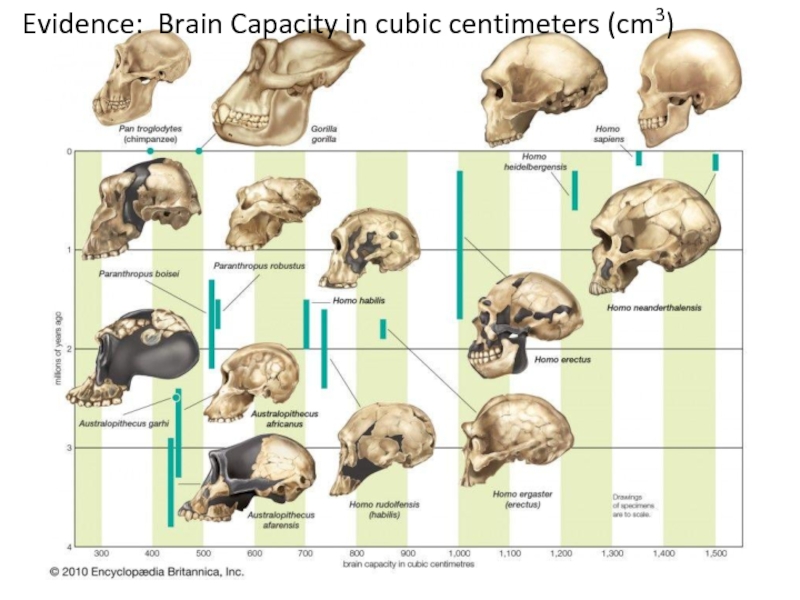
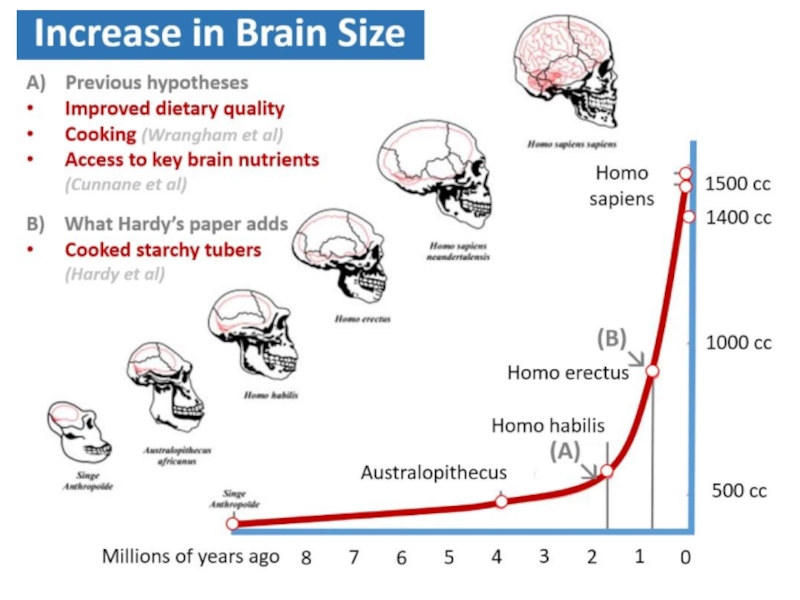
- 5. Evidence: Brain Capacity in cubic centimeters (cm3)
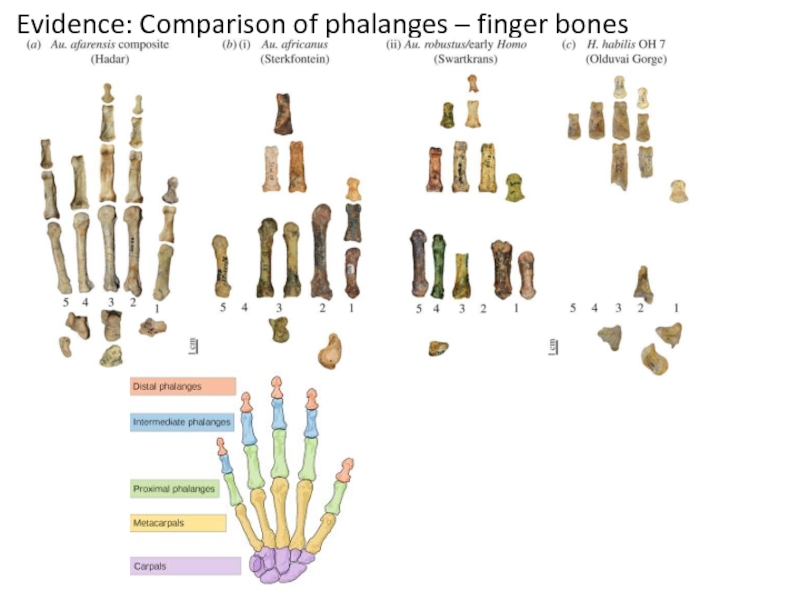
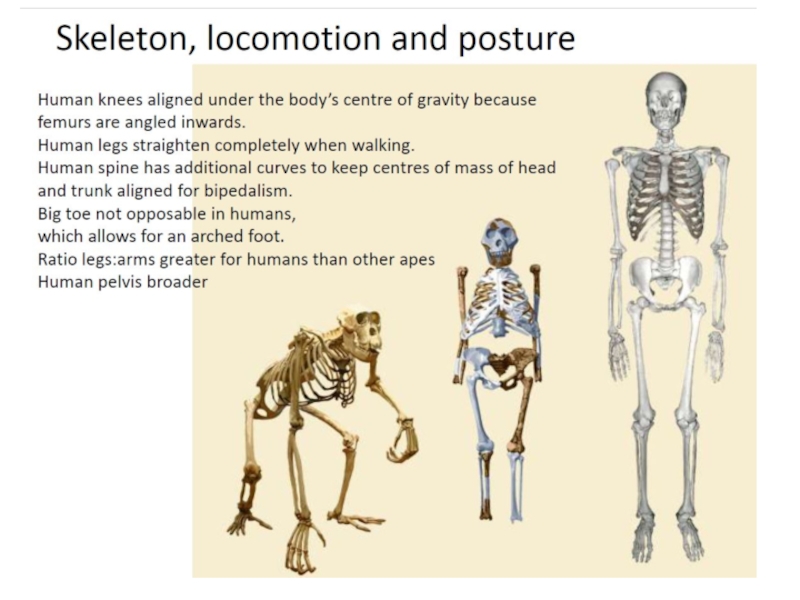
- 6. Evidence: Comparison of phalanges – finger bones
- 7. Слайд 7
- 8. Слайд 8
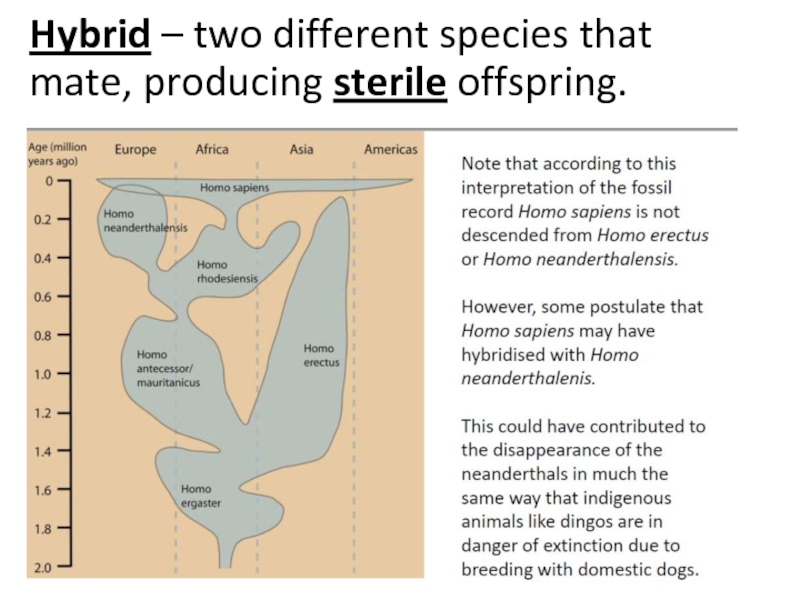
- 9. Hybrid – two different species that mate, producing sterile offspring.
- 10. Слайд 10
- 11. Research Criteria -AnthropogenesisSmithsonian http://humanorigins.si.edu/research -timeline and other Handprint
- 12. Some characteristics are thought to be a
- 13. Слайд 13
- 14. Слайд 14
- 15. Слайд 15
- 16. Слайд 16
- 17. Genus AustralopithecusThe Australopithecines are early hominins existing
- 18. Australopithecus afarensis(3.9-3 mya)An 40% complete skeleton was
- 19. Australopithecus africanus(3-2.3 mya)Fossil remains (South Africa), included
- 20. A.robustus (2.2-1.5 mya)A.boisei (2.2-1 mya)These two species
- 21. Which was our ancestor?It is generally agreed
- 22. Genus HomoThe Homo genus came into existence
- 23. Another climate changeAt about 2.5 mya (when
- 24. H. habilis / H. rudolfensis(2.3-1.44 mya)Homo habilis
- 25. H. ergaster/ H. erectus(1.9 mya - 100,000ya)Whether
- 26. H. neanderthalensis(400,000ya - 30,000ya)Like modern humans, Neanderthals
- 27. H. sapiens(200,000 ya - present)Anatomically, modern H.sapiens
- 28. Скачать презентанцию
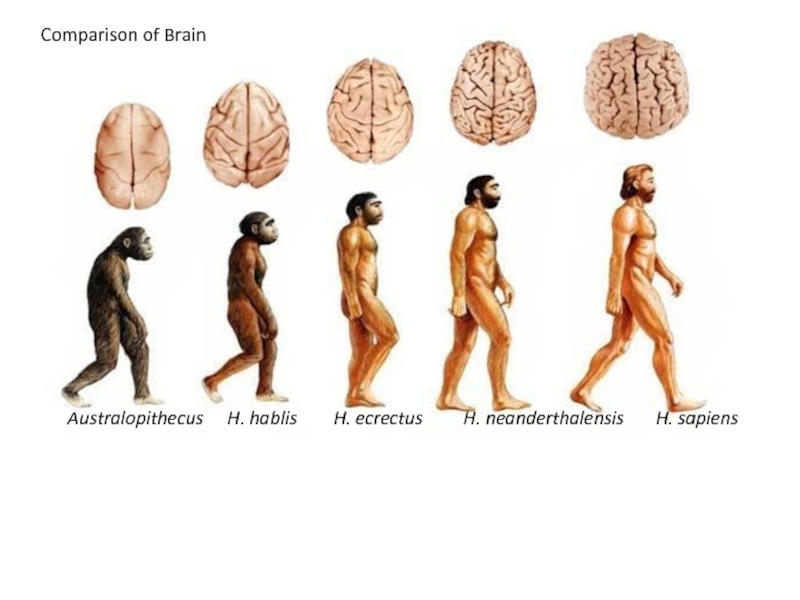
Australopithecus H. hablis H. ecrectus H. neanderthalensis H. sapiensComparison of Brain
Слайды и текст этой презентации

Слайд 11Research Criteria -Anthropogenesis
Smithsonian http://humanorigins.si.edu/research
-timeline and other
Handprint https://www.handprint.com/LS/ANC/evol.html
Human Evolution Timeline
– determine
a. Did they co-exist with any of the
other hominds? b. Time range when they existed.
c. Essay -
Your group is assigned one Hominid to research.
Create an poster with the main criteria
Create a stick figure with the head attached. (height)
Use information given, notes and website to create posters of comparision.
Слайд 12Some characteristics are thought to be a result of neoteny:
when juvenile characteristics are retained by the adults of a
species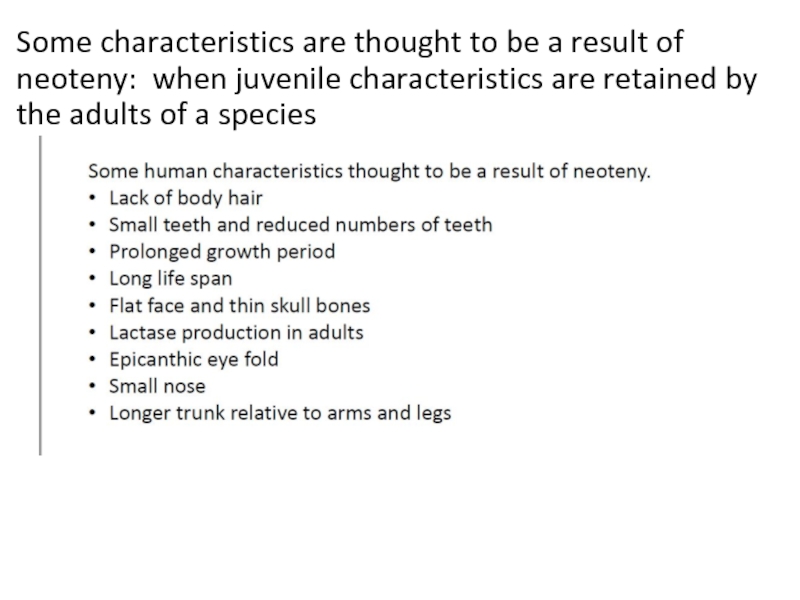
Слайд 17Genus Australopithecus
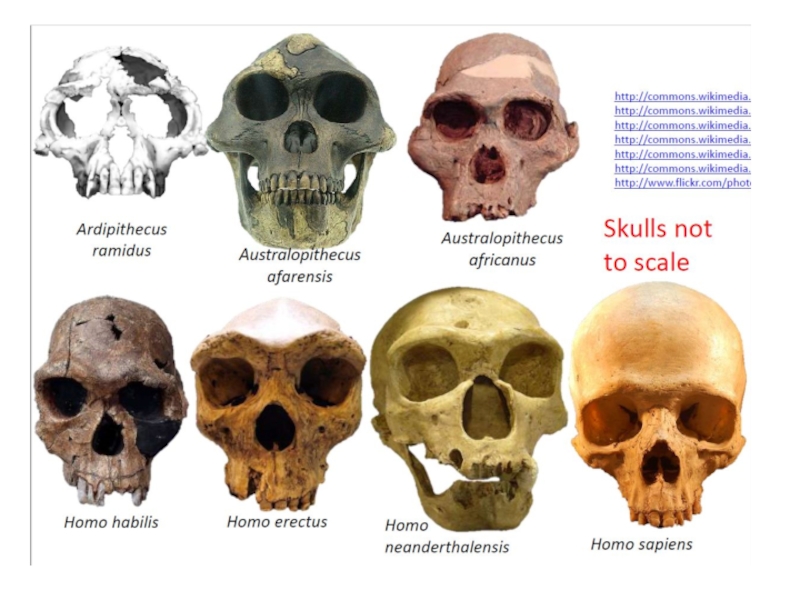
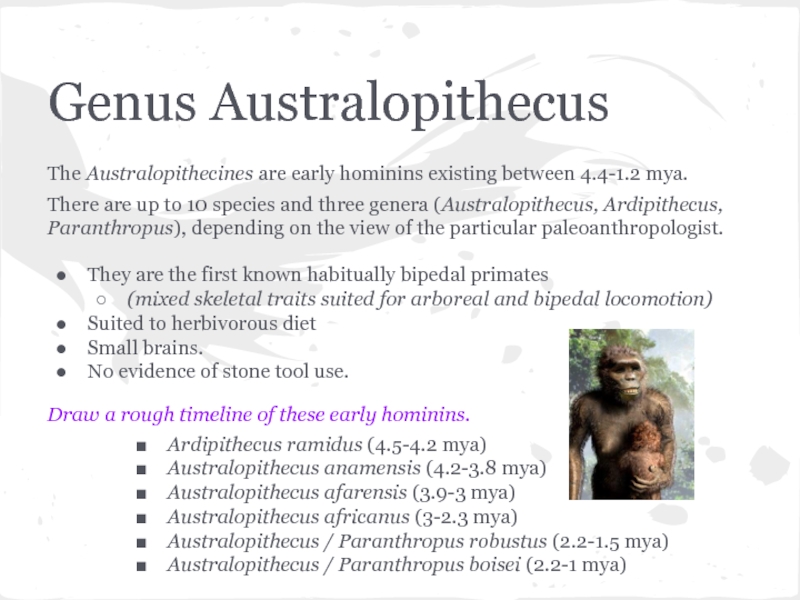
The Australopithecines are early hominins existing between 4.4-1.2 mya.
There
are up to 10 species and three genera (Australopithecus, Ardipithecus,
Paranthropus), depending on the view of the particular paleoanthropologist.They are the first known habitually bipedal primates
(mixed skeletal traits suited for arboreal and bipedal locomotion)
Suited to herbivorous diet
Small brains.
No evidence of stone tool use.
Draw a rough timeline of these early hominins.
Ardipithecus ramidus (4.5-4.2 mya)
Australopithecus anamensis (4.2-3.8 mya)
Australopithecus afarensis (3.9-3 mya)
Australopithecus africanus (3-2.3 mya)
Australopithecus / Paranthropus robustus (2.2-1.5 mya)
Australopithecus / Paranthropus boisei (2.2-1 mya)
Слайд 18Australopithecus afarensis
(3.9-3 mya)
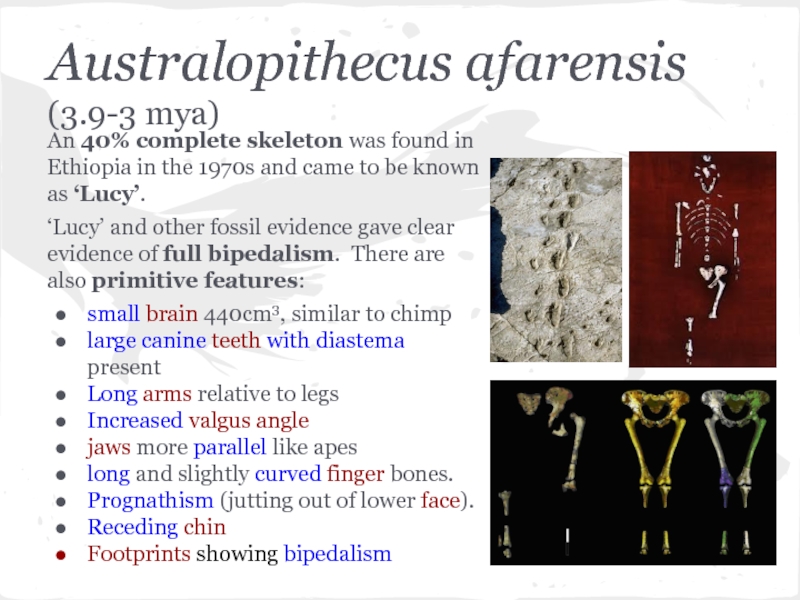
An 40% complete skeleton was found in Ethiopia
in the 1970s and came to be known as ‘Lucy’.
‘Lucy’
and other fossil evidence gave clear evidence of full bipedalism. There are also primitive features:small brain 440cm3, similar to chimp
large canine teeth with diastema present
Long arms relative to legs
Increased valgus angle
jaws more parallel like apes
long and slightly curved finger bones.
Prognathism (jutting out of lower face).
Receding chin
Footprints showing bipedalism
Слайд 19Australopithecus africanus
(3-2.3 mya)
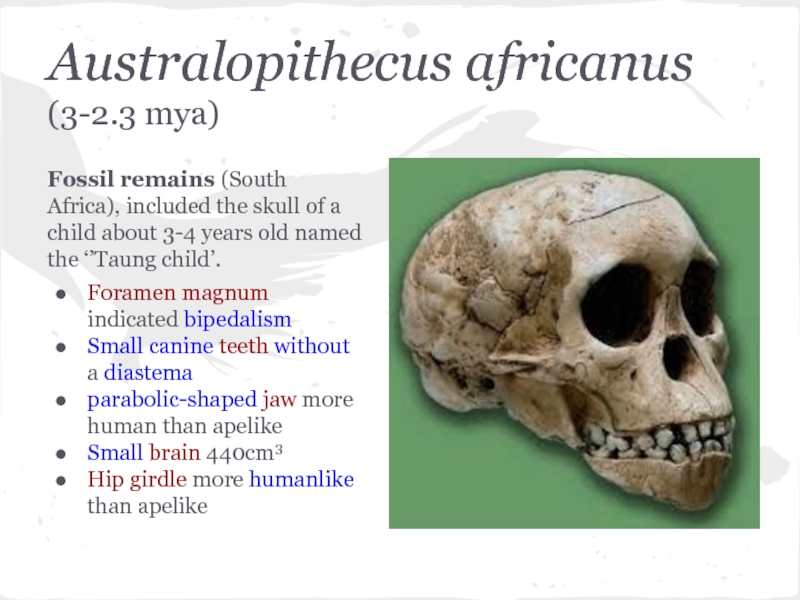
Fossil remains (South Africa), included the skull of
a child about 3-4 years old named the ‘’Taung child’.
Foramen
magnum indicated bipedalismSmall canine teeth without a diastema
parabolic-shaped jaw more human than apelike
Small brain 440cm3
Hip girdle more humanlike than apelike
Слайд 20A.robustus (2.2-1.5 mya)
A.boisei (2.2-1 mya)
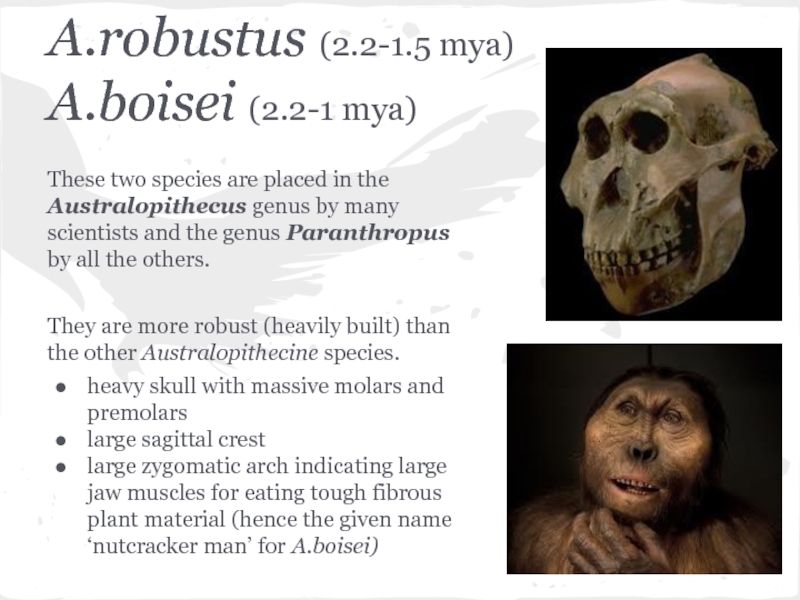
These two species are placed in
the Australopithecus genus by many scientists and the genus Paranthropus
by all the others.They are more robust (heavily built) than the other Australopithecine species.
heavy skull with massive molars and premolars
large sagittal crest
large zygomatic arch indicating large jaw muscles for eating tough fibrous plant material (hence the given name ‘nutcracker man’ for A.boisei)
Слайд 21Which was our ancestor?
It is generally agreed that:
A.anamensis and A.afarensis
were likely to have been ancestral to Homo genus
A.ramidus was
likely to have been close to the ancestor of both humans and apesAustralopithecus/Paranthropus robustus and boisei were specialised herbivorous forms that were evolutionary dead ends; i.e left no present-day descendants.
Слайд 22Genus Homo
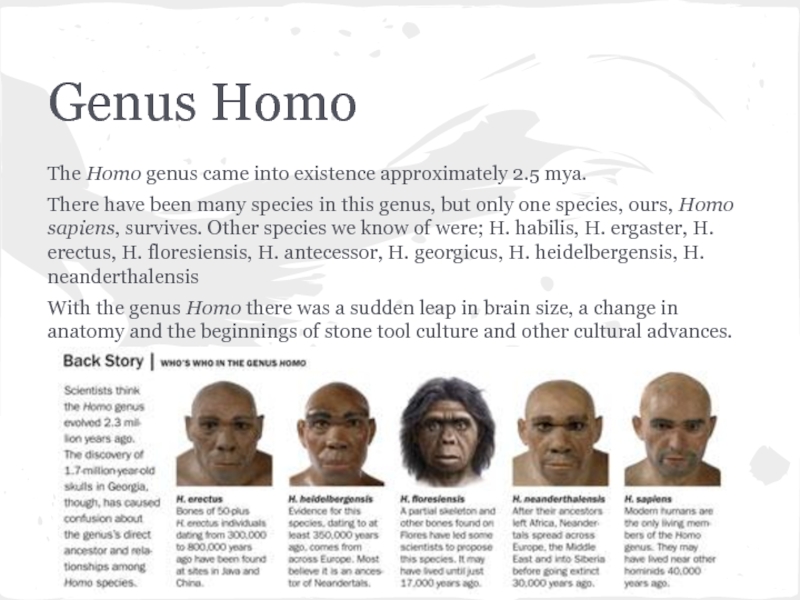
The Homo genus came into existence approximately 2.5 mya.
There
have been many species in this genus, but only one
species, ours, Homo sapiens, survives. Other species we know of were; H. habilis, H. ergaster, H. erectus, H. floresiensis, H. antecessor, H. georgicus, H. heidelbergensis, H. neanderthalensisWith the genus Homo there was a sudden leap in brain size, a change in anatomy and the beginnings of stone tool culture and other cultural advances.
Слайд 23Another climate change
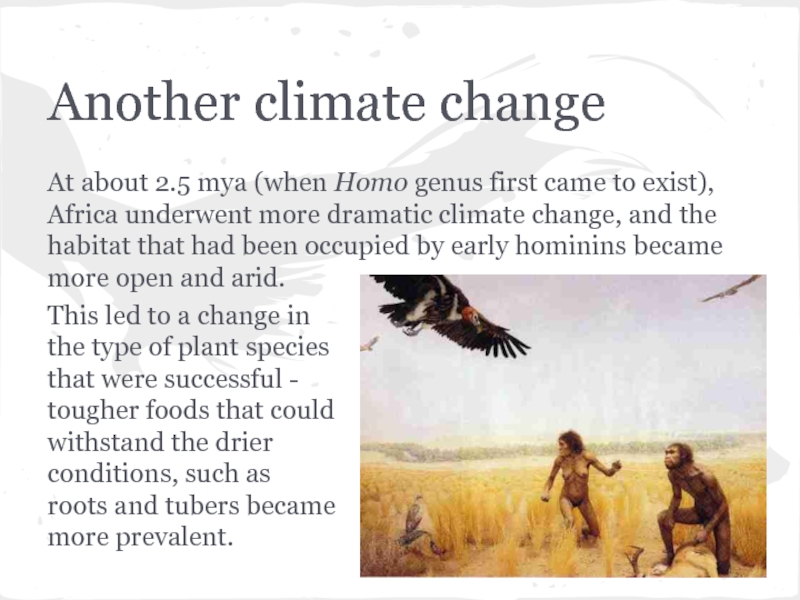
At about 2.5 mya (when Homo genus first
came to exist), Africa underwent more dramatic climate change, and
the habitat that had been occupied by early hominins became more open and arid.This led to a change in the type of plant species that were successful - tougher foods that could withstand the drier conditions, such as roots and tubers became more prevalent.
Слайд 24H. habilis / H. rudolfensis
(2.3-1.44 mya)
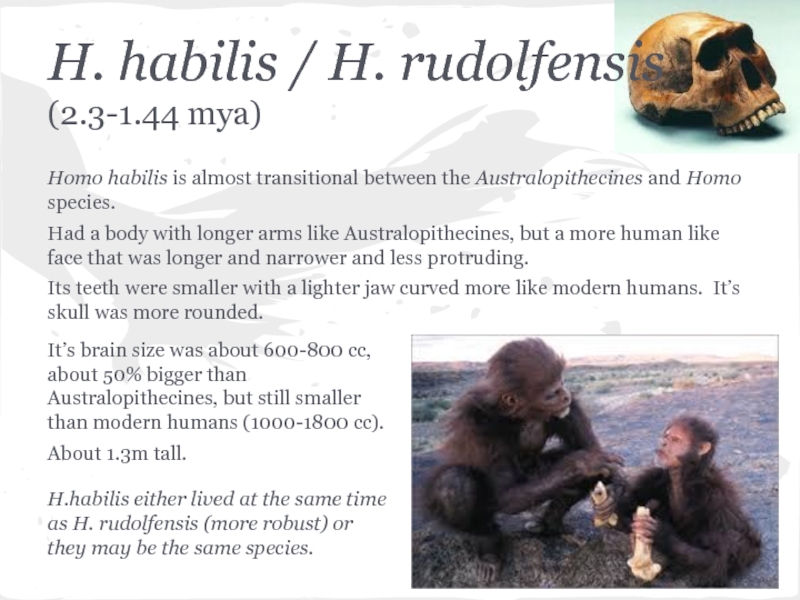
Homo habilis is almost transitional
between the Australopithecines and Homo species.
Had a body with longer
arms like Australopithecines, but a more human like face that was longer and narrower and less protruding.Its teeth were smaller with a lighter jaw curved more like modern humans. It’s skull was more rounded.
It’s brain size was about 600-800 cc, about 50% bigger than Australopithecines, but still smaller than modern humans (1000-1800 cc).
About 1.3m tall.
H.habilis either lived at the same time as H. rudolfensis (more robust) or they may be the same species.
Слайд 25H. ergaster/ H. erectus
(1.9 mya - 100,000ya)
Whether H. ergaster and
H.erectus are two species or one is uncertain. H. ergaster
(who remained in Africa) may have diverged from H. erectus (who migrated to Asia), or they may be different populations of the same species, H. erectus, living in different areas.The African population is believed to be the ancestor of later Homo species H. heidelbergensis, H. neanderthalensis and H. sapiens (us).
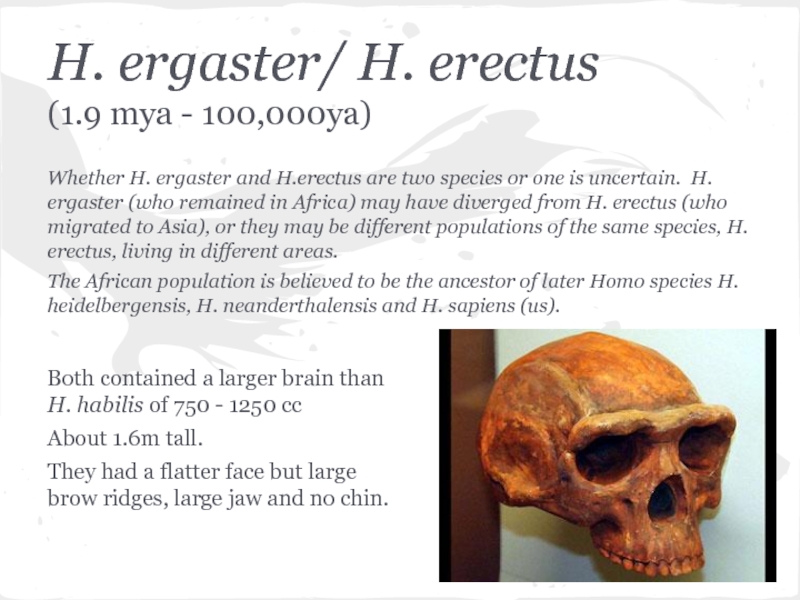
Both contained a larger brain than H. habilis of 750 - 1250 cc
About 1.6m tall.
They had a flatter face but large brow ridges, large jaw and no chin.
Слайд 26H. neanderthalensis
(400,000ya - 30,000ya)
Like modern humans, Neanderthals (pronounced with a
silent h, ‘Nee-an-der-tal’), were members of the Homo genus. They
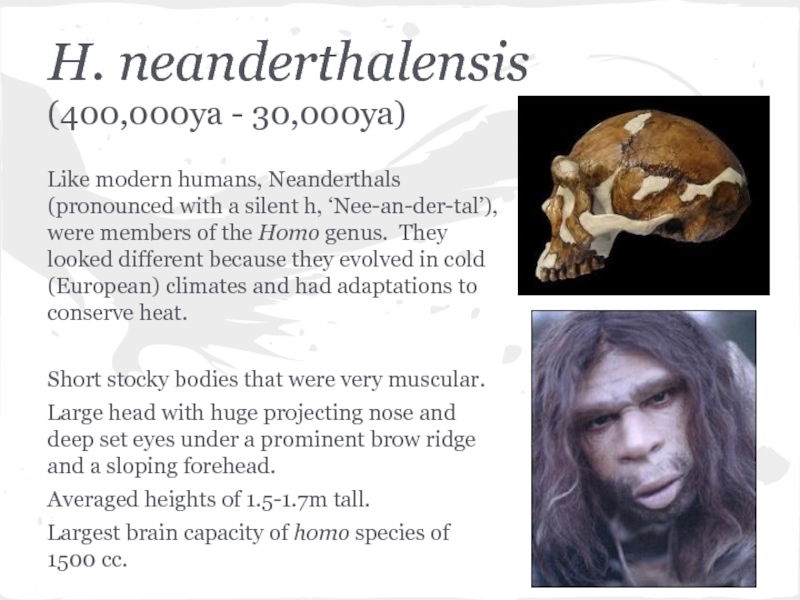
looked different because they evolved in cold (European) climates and had adaptations to conserve heat.Short stocky bodies that were very muscular.
Large head with huge projecting nose and deep set eyes under a prominent brow ridge and a sloping forehead.
Averaged heights of 1.5-1.7m tall.
Largest brain capacity of homo species of 1500 cc.
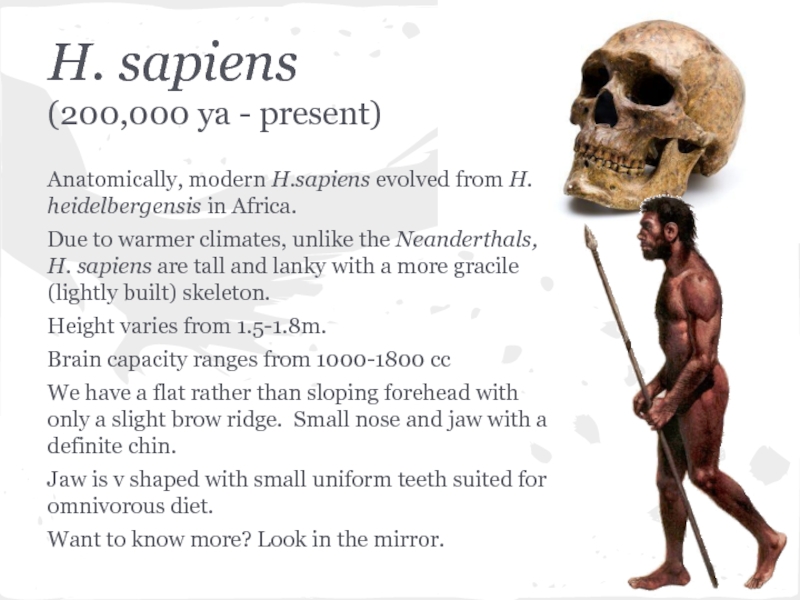
Слайд 27H. sapiens
(200,000 ya - present)
Anatomically, modern H.sapiens evolved from H.
heidelbergensis in Africa.
Due to warmer climates, unlike the Neanderthals, H.
sapiens are tall and lanky with a more gracile (lightly built) skeleton. Height varies from 1.5-1.8m.
Brain capacity ranges from 1000-1800 cc
We have a flat rather than sloping forehead with only a slight brow ridge. Small nose and jaw with a definite chin.
Jaw is v shaped with small uniform teeth suited for omnivorous diet.
Want to know more? Look in the mirror.