Разделы презентаций
- Разное
- Английский язык
- Астрономия
- Алгебра
- Биология
- География
- Геометрия
- Детские презентации
- Информатика
- История
- Литература
- Математика
- Медицина
- Менеджмент
- Музыка
- МХК
- Немецкий язык
- ОБЖ
- Обществознание
- Окружающий мир
- Педагогика
- Русский язык
- Технология
- Физика
- Философия
- Химия
- Шаблоны, картинки для презентаций
- Экология
- Экономика
- Юриспруденция
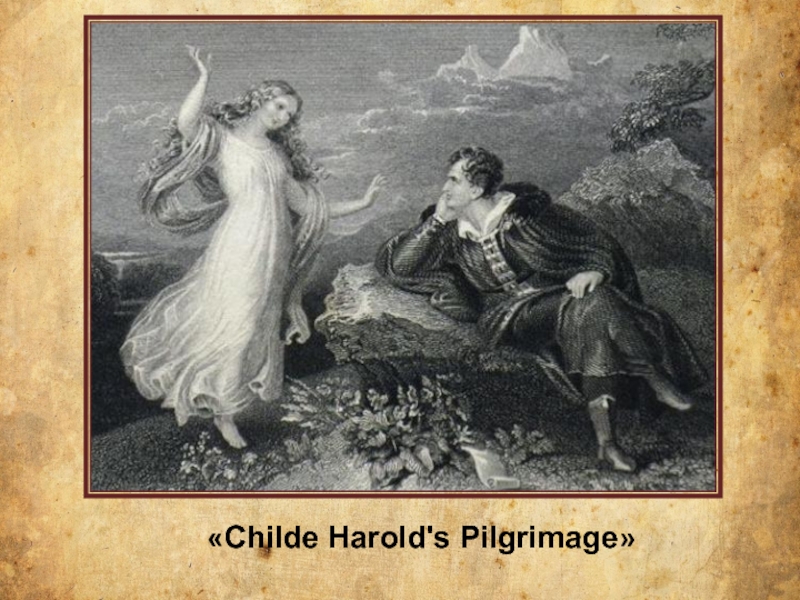
Childe Harold's Pilgrimage
Содержание
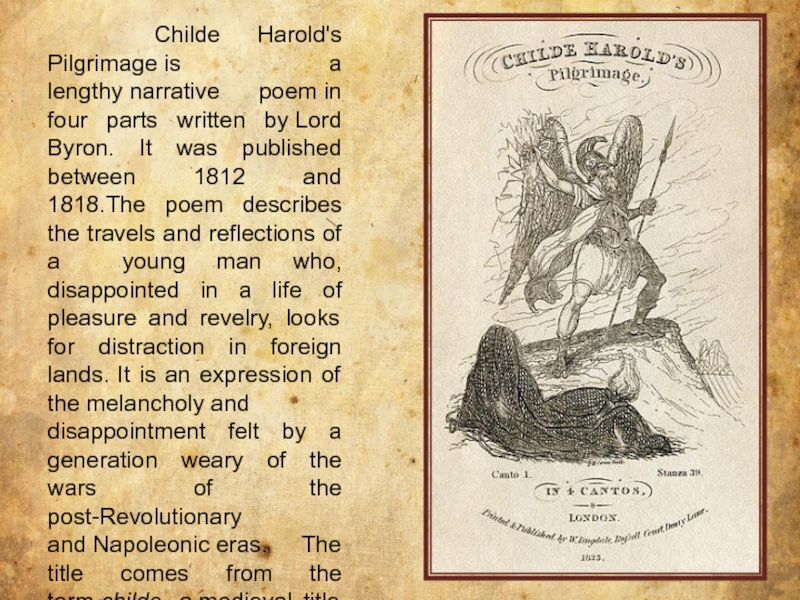
Childe Harold's Pilgrimage is a lengthy narrative poem in four parts written by Lord Byron. It was published between 1812 and 1818.The poem describes the travels and reflections of a young man who,
Слайды и текст этой презентации
Слайд 3 The poem contains elements thought to be autobiographical,
as Byron generated some of the storyline from experience gained
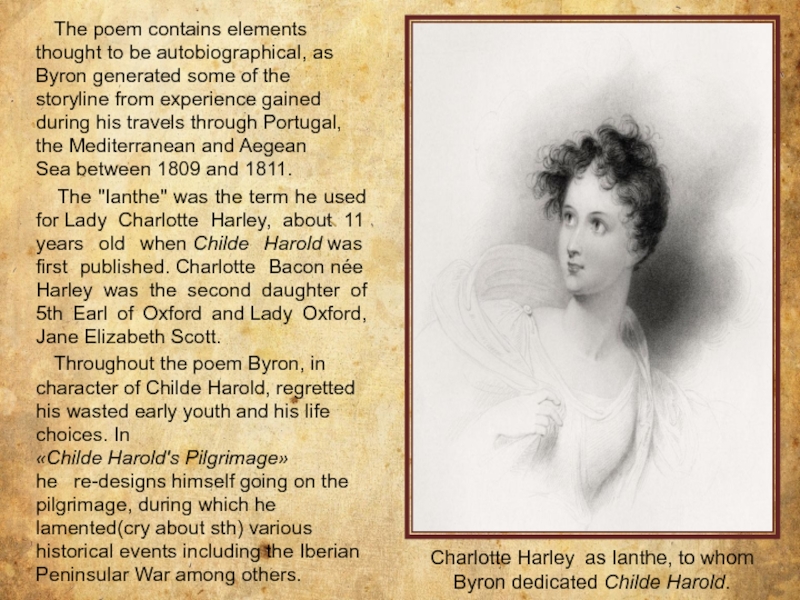
during his travels through Portugal, the Mediterranean and Aegean Sea between 1809 and 1811.The "Ianthe" was the term he used for Lady Charlotte Harley, about 11 years old when Childe Harold was first published. Charlotte Bacon née Harley was the second daughter of 5th Earl of Oxford and Lady Oxford, Jane Elizabeth Scott.
Throughout the poem Byron, in character of Childe Harold, regretted his wasted early youth and his life choices. In «Childe Harold's Pilgrimage» he re-designs himself going on the pilgrimage, during which he lamented(cry about sth) various historical events including the Iberian Peninsular War among others.
Charlotte Harley as Ianthe, to whom Byron dedicated Childe Harold.
Слайд 4Despite Byron's initial hesitation at having the first two cantos
of the poem published because he felt it revealed too
much of himself, it was published, at the urging of friends, by John Murray in 1812, and brought both the poem and its author to immediate and unexpected public attention. Byron later wrote, "I awoke one morning and found myself famous". The first two cantos in John Murray's edition were illustrated by Richard Westall, well-known painter and illustrator who was then commissioned to paint portraits of Byron. Published in March, 1812, the first run of 500 quarto copies sold out in three days. There were ten editions of the work within three years. Byron deemed the work "my best" in 1817.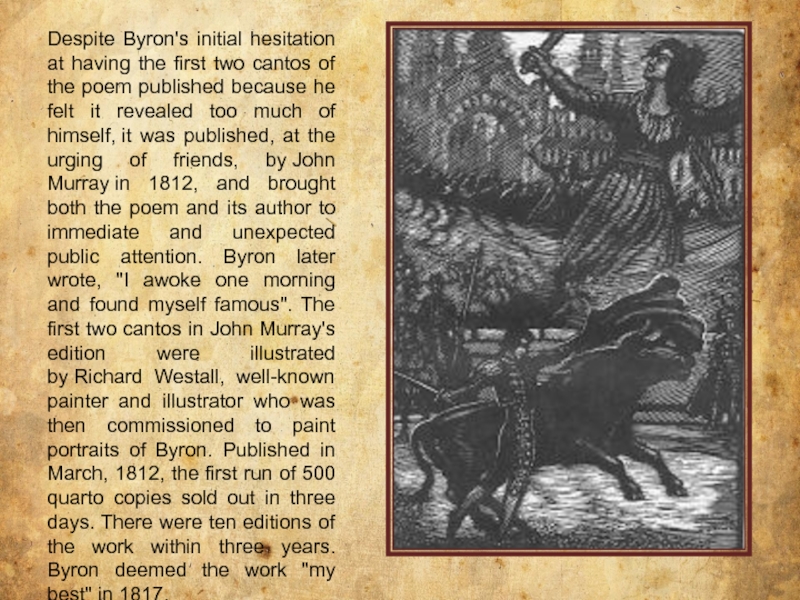
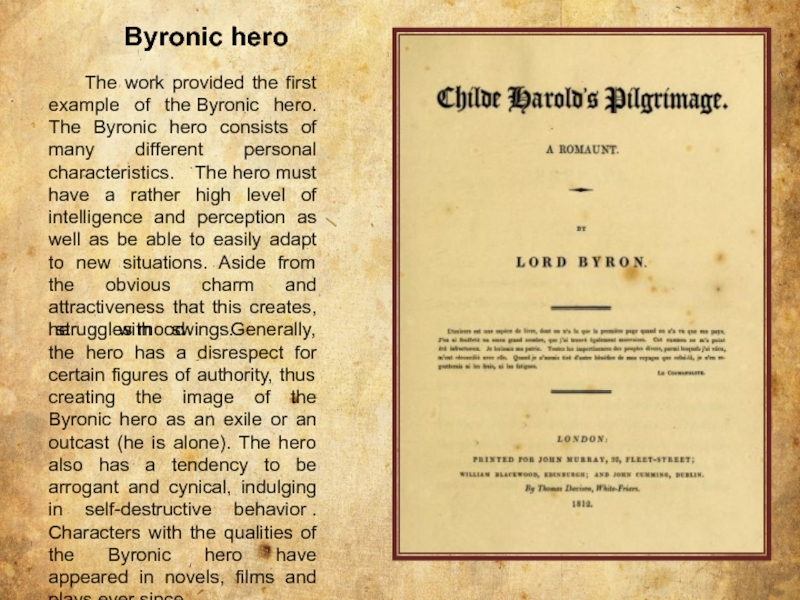
Слайд 5 The work provided the first example of
the Byronic hero. The Byronic hero consists of many different personal
characteristics. The hero must have a rather high level of intelligence and perception as well as be able to easily adapt to new situations. Aside from the obvious charm and attractiveness that this creates, he struggles with mood swings. Generally, the hero has a disrespect for certain figures of authority, thus creating the image of the Byronic hero as an exile or an outcast (he is alone). The hero also has a tendency to be arrogant and cynical, indulging in self-destructive behavior . Characters with the qualities of the Byronic hero have appeared in novels, films and plays ever since. Byronic hero