Разделы презентаций


You are assigned to care for Mrs. Jones, an 84-year-old woman who was admitted

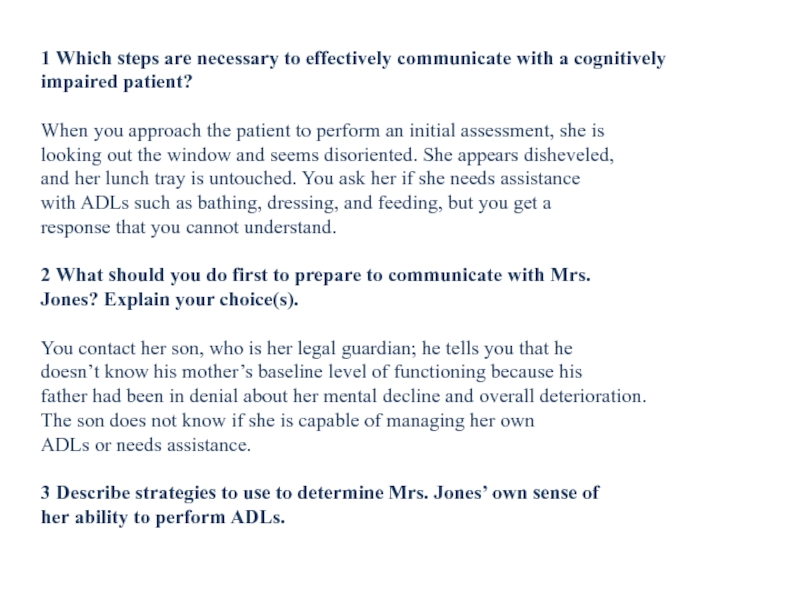
1 Which steps are necessary to effectively communicate with a cognitivelyimpaired patient?When you approach the patient to perform an initial assessment, she islooking out the window and seems disoriented. She appears

Слайды и текст этой презентации

Слайд 1You are assigned to care for Mrs. Jones, an 84-year-old

woman who
was admitted to the hospital 2 days ago after

falling at her son’s home.
She recently moved in with her son, her only child, following the sudden
death of her husband.
Her husband had been her primary caregiver since she was diagnosed with
Alzheimer’s disease 3 years ago.

Neither her husband nor her son wanted to put her into a long-term care facility.

She had emergency surgery to repair a fractured wrist.
During shift report on a medical-surgical unit, the nurse tells you that the patient is
withdrawn and confused.

In addition, she has difficulty understanding verbal direction from the nursing staff.
You are assigned to care for Mrs. Jones, an 84-year-old woman whowas admitted to the hospital 2

Слайд 21 Which steps are necessary to effectively communicate with a

cognitively
impaired patient?

When you approach the patient to perform an initial

assessment, she is
looking out the window and seems disoriented. She appears disheveled,
and her lunch tray is untouched. You ask her if she needs assistance
with ADLs such as bathing, dressing, and feeding, but you get a
response that you cannot understand.

2 What should you do first to prepare to communicate with Mrs.
Jones? Explain your choice(s).

You contact her son, who is her legal guardian; he tells you that he
doesn’t know his mother’s baseline level of functioning because his
father had been in denial about her mental decline and overall deterioration.
The son does not know if she is capable of managing her own
ADLs or needs assistance.

3 Describe strategies to use to determine Mrs. Jones’ own sense of
her ability to perform ADLs.
1 Which steps are necessary to effectively communicate with a cognitivelyimpaired patient?When you approach the patient to

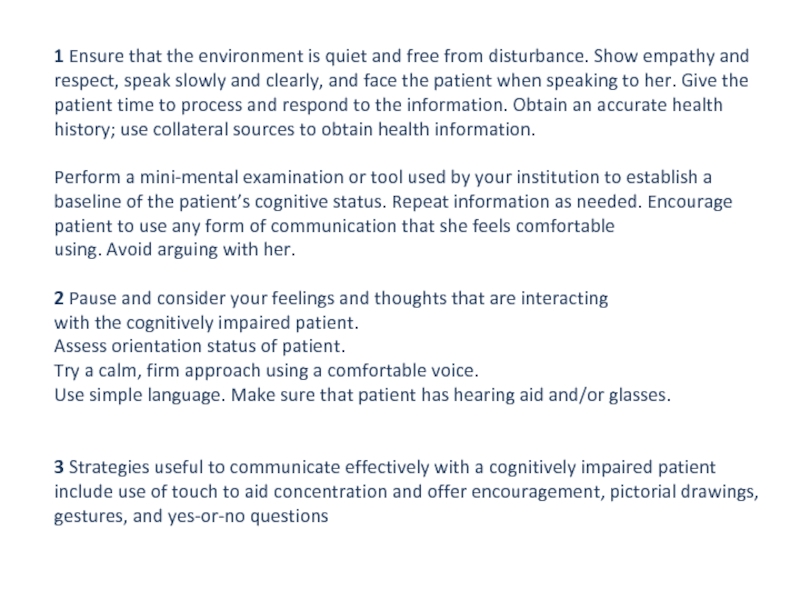
Слайд 31 Ensure that the environment is quiet and free from

disturbance. Show empathy and respect, speak slowly and clearly, and

face the patient when speaking to her. Give the patient time to process and respond to the information. Obtain an accurate health history; use collateral sources to obtain health information.

Perform a mini-mental examination or tool used by your institution to establish a baseline of the patient’s cognitive status. Repeat information as needed. Encourage
patient to use any form of communication that she feels comfortable
using. Avoid arguing with her.

2 Pause and consider your feelings and thoughts that are interacting
with the cognitively impaired patient.
Assess orientation status of patient.
Try a calm, firm approach using a comfortable voice.
Use simple language. Make sure that patient has hearing aid and/or glasses.


3 Strategies useful to communicate effectively with a cognitively impaired patient include use of touch to aid concentration and offer encouragement, pictorial drawings, gestures, and yes-or-no questions
1 Ensure that the environment is quiet and free from disturbance. Show empathy and respect, speak slowly

Слайд 4Which approach reflects an obstacle to effective nurse-patient communication?
1 Discussing

fears about a patient with members of the health care

team

2 Obtaining information about a critically ill patient from his or her family

3 Avoiding issues that are uncomfortable for a patient
Which approach reflects an obstacle to effective nurse-patient communication?1 Discussing fears about a patient with members of

Слайд 5Which approach reflects an obstacle to effective nurse-patient communication?
1 Discussing

fears about a patient with members of the health care

team

2 Obtaining information about a critically ill patient from his or her family

3 Avoiding issues that are uncomfortable for a patient

Rationale: A therapeutic nurse-patient relationship is goal directed.

It can also include the need to help a patient discuss any pertinent topics, whether comfortable or uncomfortable

Which approach reflects an obstacle to effective nurse-patient communication?1 Discussing fears about a patient with members of

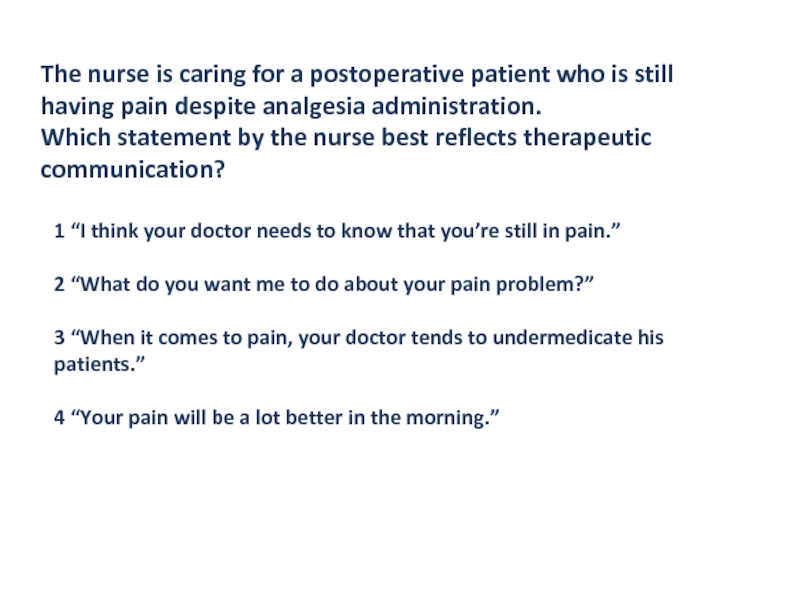
Слайд 6The nurse is caring for a postoperative patient who is

still having pain despite analgesia administration.
Which statement by the

nurse best reflects therapeutic communication?

1 “I think your doctor needs to know that you’re still in pain.”

2 “What do you want me to do about your pain problem?”

3 “When it comes to pain, your doctor tends to undermedicate his patients.”

4 “Your pain will be a lot better in the morning.”

The nurse is caring for a postoperative patient who is still having pain despite analgesia administration. Which

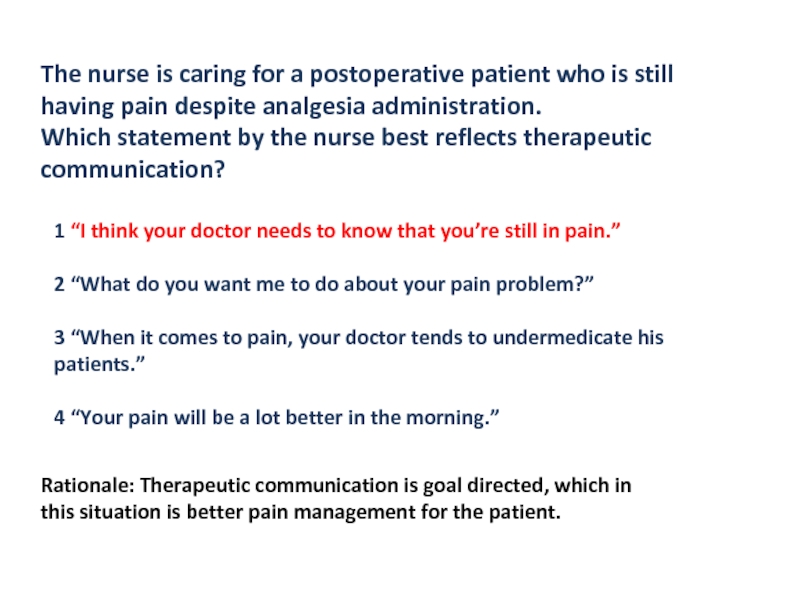
Слайд 7The nurse is caring for a postoperative patient who is

still having pain despite analgesia administration.
Which statement by the

nurse best reflects therapeutic communication?

1 “I think your doctor needs to know that you’re still in pain.”

2 “What do you want me to do about your pain problem?”

3 “When it comes to pain, your doctor tends to undermedicate his patients.”

4 “Your pain will be a lot better in the morning.”

Rationale: Therapeutic communication is goal directed, which in
this situation is better pain management for the patient.

The nurse is caring for a postoperative patient who is still having pain despite analgesia administration. Which

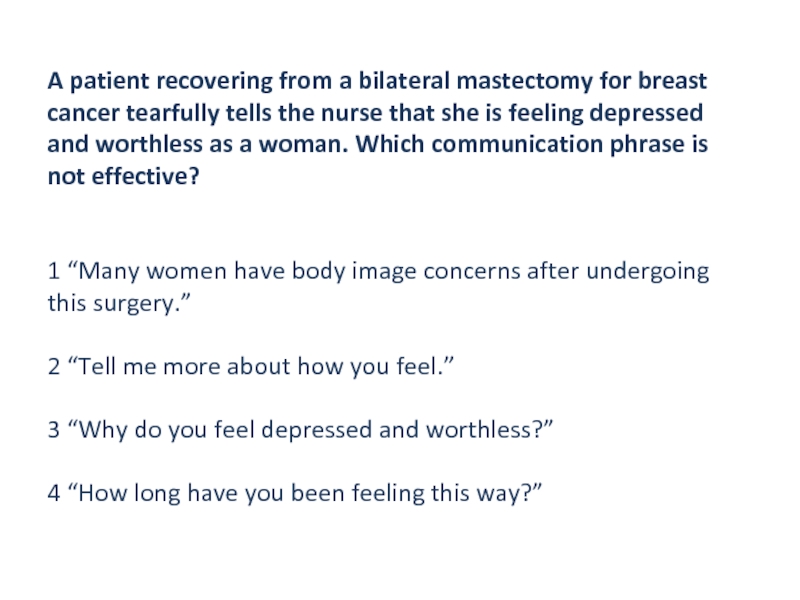
Слайд 8A patient recovering from a bilateral mastectomy for breast cancer

tearfully tells the nurse that she is feeling depressed and

worthless as a woman. Which communication phrase is not effective?


1 “Many women have body image concerns after undergoing this surgery.”

2 “Tell me more about how you feel.”

3 “Why do you feel depressed and worthless?”

4 “How long have you been feeling this way?”
A patient recovering from a bilateral mastectomy for breast cancer tearfully tells the nurse that she is

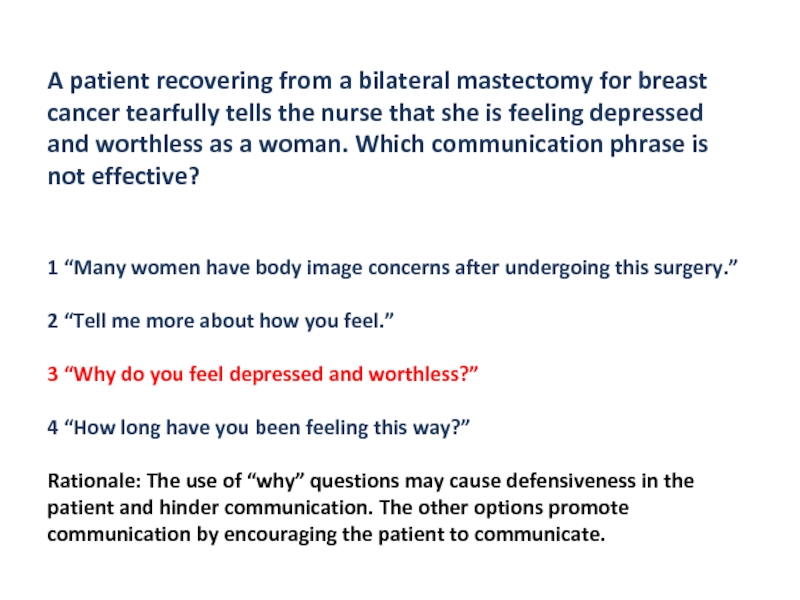
Слайд 9A patient recovering from a bilateral mastectomy for breast cancer

tearfully tells the nurse that she is feeling depressed and

worthless as a woman. Which communication phrase is not effective?


1 “Many women have body image concerns after undergoing this surgery.”

2 “Tell me more about how you feel.”

3 “Why do you feel depressed and worthless?”

4 “How long have you been feeling this way?”

Rationale: The use of “why” questions may cause defensiveness in the patient and hinder communication. The other options promote communication by encouraging the patient to communicate.
A patient recovering from a bilateral mastectomy for breast cancer tearfully tells the nurse that she is

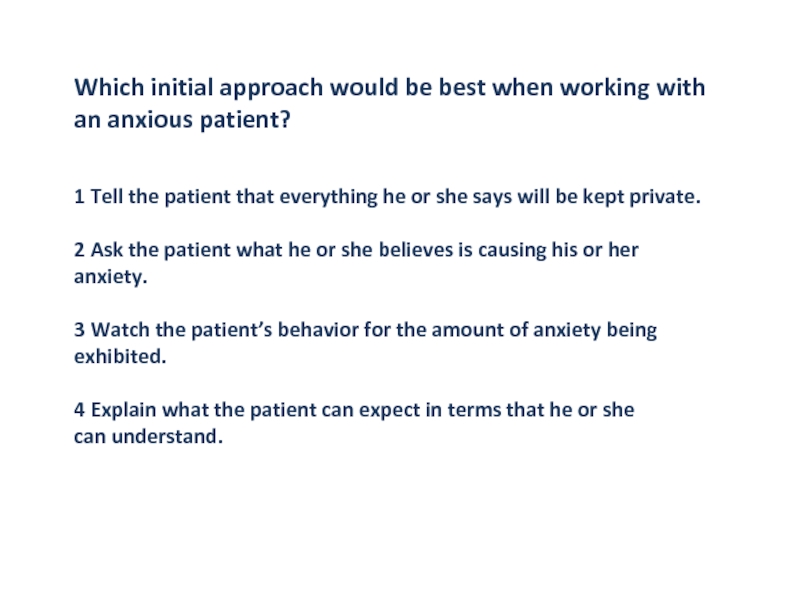
Слайд 10Which initial approach would be best when working with an

anxious patient?


1 Tell the patient that everything he or she

says will be kept private.

2 Ask the patient what he or she believes is causing his or her
anxiety.

3 Watch the patient’s behavior for the amount of anxiety being
exhibited.

4 Explain what the patient can expect in terms that he or she
can understand.
Which initial approach would be best when working with an anxious patient?1 Tell the patient that everything

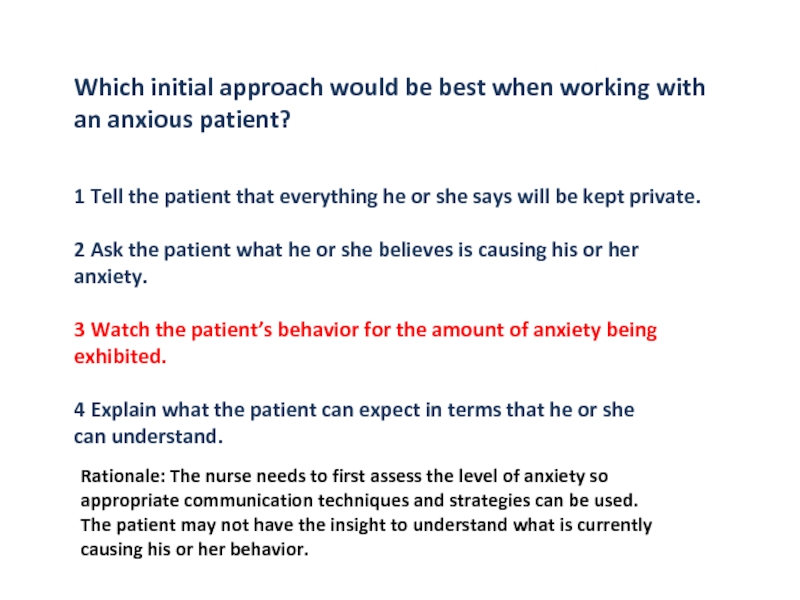
Слайд 11Which initial approach would be best when working with an

anxious patient?


1 Tell the patient that everything he or she

says will be kept private.

2 Ask the patient what he or she believes is causing his or her
anxiety.

3 Watch the patient’s behavior for the amount of anxiety being
exhibited.

4 Explain what the patient can expect in terms that he or she
can understand.

Rationale: The nurse needs to first assess the level of anxiety so
appropriate communication techniques and strategies can be used.
The patient may not have the insight to understand what is currently causing his or her behavior.

Which initial approach would be best when working with an anxious patient?1 Tell the patient that everything

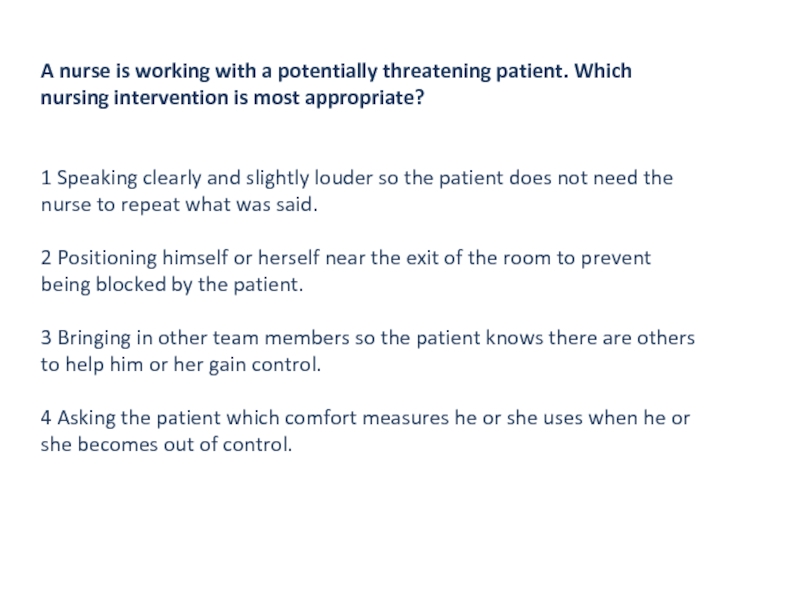
Слайд 12A nurse is working with a potentially threatening patient. Which
nursing

intervention is most appropriate?


1 Speaking clearly and slightly louder so

the patient does not need the nurse to repeat what was said.

2 Positioning himself or herself near the exit of the room to prevent being blocked by the patient.

3 Bringing in other team members so the patient knows there are others to help him or her gain control.

4 Asking the patient which comfort measures he or she uses when he or she becomes out of control.
A nurse is working with a potentially threatening patient. Whichnursing intervention is most appropriate?1 Speaking clearly and

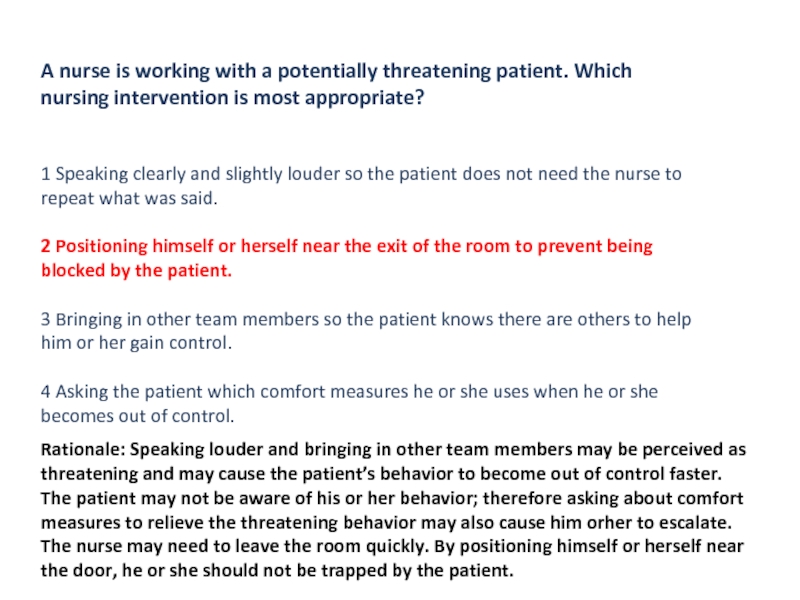
Слайд 13A nurse is working with a potentially threatening patient. Which
nursing

intervention is most appropriate?


1 Speaking clearly and slightly louder so

the patient does not need the nurse to repeat what was said.

2 Positioning himself or herself near the exit of the room to prevent being blocked by the patient.

3 Bringing in other team members so the patient knows there are others to help him or her gain control.

4 Asking the patient which comfort measures he or she uses when he or she becomes out of control.

Rationale: Speaking louder and bringing in other team members may be perceived as threatening and may cause the patient’s behavior to become out of control faster. The patient may not be aware of his or her behavior; therefore asking about comfort measures to relieve the threatening behavior may also cause him orher to escalate. The nurse may need to leave the room quickly. By positioning himself or herself near the door, he or she should not be trapped by the patient.

A nurse is working with a potentially threatening patient. Whichnursing intervention is most appropriate?1 Speaking clearly and

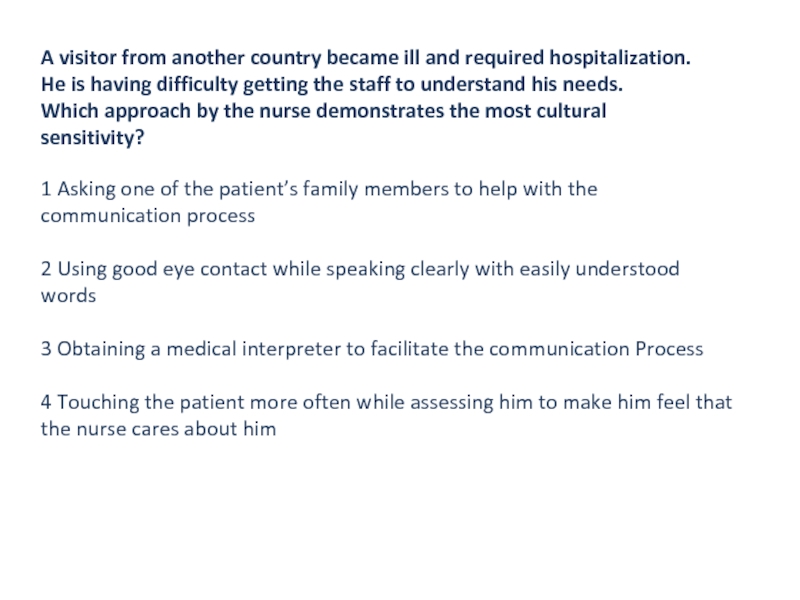
Слайд 14A visitor from another country became ill and required hospitalization.
He

is having difficulty getting the staff to understand his needs.
Which

approach by the nurse demonstrates the most cultural
sensitivity?

1 Asking one of the patient’s family members to help with the communication process

2 Using good eye contact while speaking clearly with easily understood words

3 Obtaining a medical interpreter to facilitate the communication Process

4 Touching the patient more often while assessing him to make him feel that the nurse cares about him
A visitor from another country became ill and required hospitalization.He is having difficulty getting the staff to

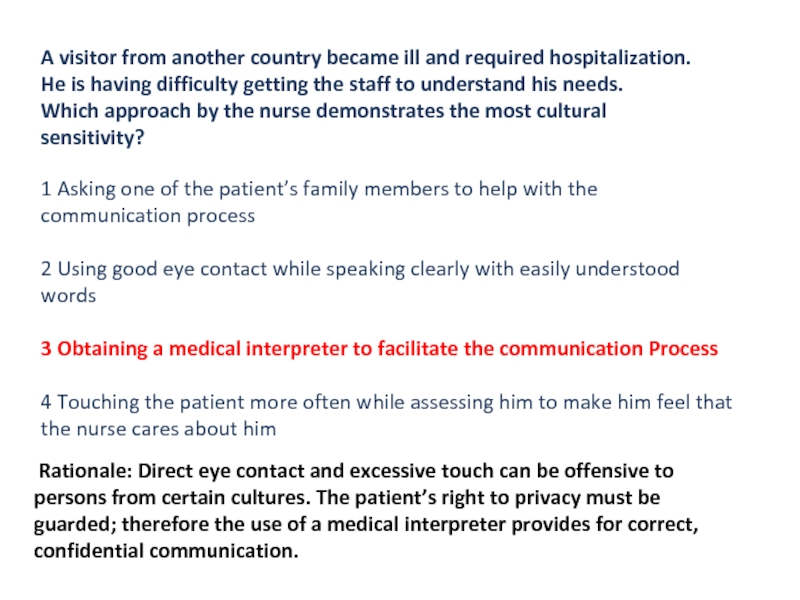
Слайд 15A visitor from another country became ill and required hospitalization.
He

is having difficulty getting the staff to understand his needs.
Which

approach by the nurse demonstrates the most cultural
sensitivity?

1 Asking one of the patient’s family members to help with the communication process

2 Using good eye contact while speaking clearly with easily understood words

3 Obtaining a medical interpreter to facilitate the communication Process

4 Touching the patient more often while assessing him to make him feel that the nurse cares about him

Rationale: Direct eye contact and excessive touch can be offensive to persons from certain cultures. The patient’s right to privacy must be guarded; therefore the use of a medical interpreter provides for correct, confidential communication.

A visitor from another country became ill and required hospitalization.He is having difficulty getting the staff to

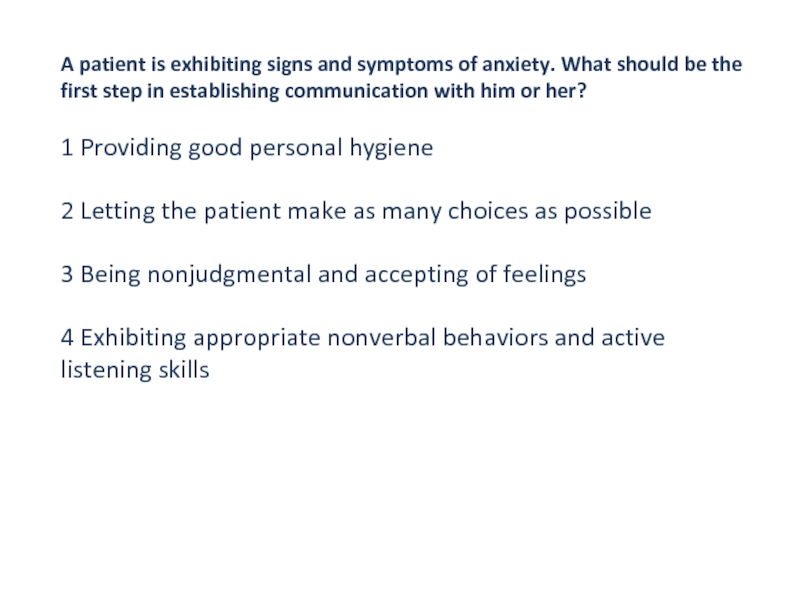
Слайд 16A patient is exhibiting signs and symptoms of anxiety. What

should be the first step in establishing communication with him

or her?

1 Providing good personal hygiene

2 Letting the patient make as many choices as possible

3 Being nonjudgmental and accepting of feelings

4 Exhibiting appropriate nonverbal behaviors and active listening skills
A patient is exhibiting signs and symptoms of anxiety. What should be the first step in establishing

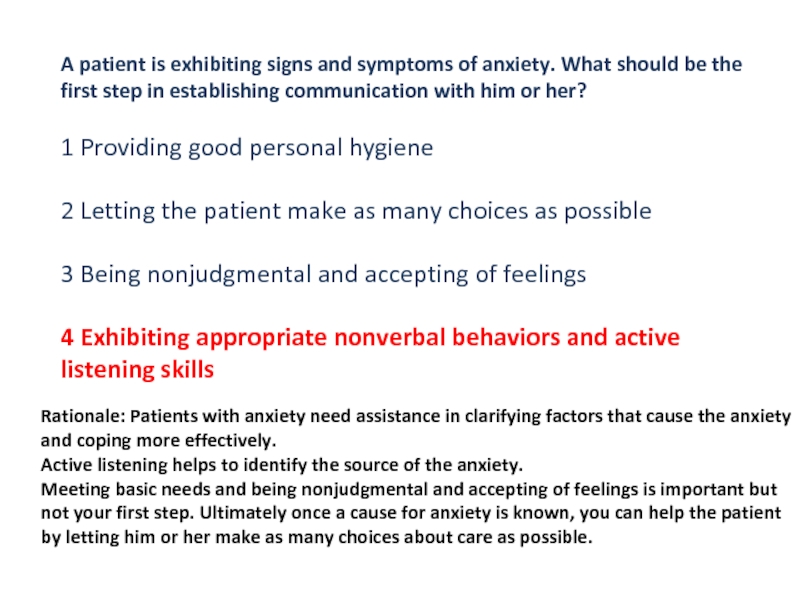
Слайд 17A patient is exhibiting signs and symptoms of anxiety. What

should be the first step in establishing communication with him

or her?

1 Providing good personal hygiene

2 Letting the patient make as many choices as possible

3 Being nonjudgmental and accepting of feelings

4 Exhibiting appropriate nonverbal behaviors and active listening skills

Rationale: Patients with anxiety need assistance in clarifying factors that cause the anxiety and coping more effectively.
Active listening helps to identify the source of the anxiety.
Meeting basic needs and being nonjudgmental and accepting of feelings is important but not your first step. Ultimately once a cause for anxiety is known, you can help the patient by letting him or her make as many choices about care as possible.

A patient is exhibiting signs and symptoms of anxiety. What should be the first step in establishing

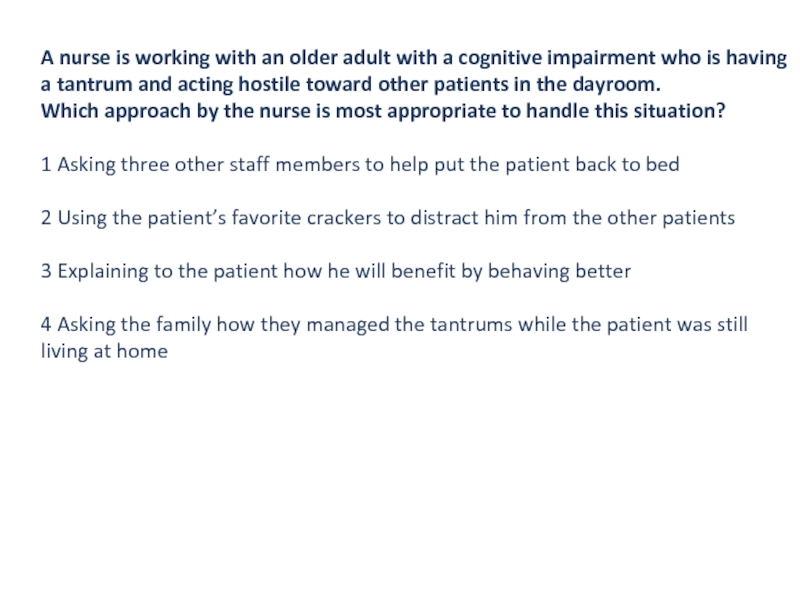
Слайд 18A nurse is working with an older adult with a

cognitive impairment who is having a tantrum and acting hostile

toward other patients in the dayroom.
Which approach by the nurse is most appropriate to handle this situation?

1 Asking three other staff members to help put the patient back to bed

2 Using the patient’s favorite crackers to distract him from the other patients

3 Explaining to the patient how he will benefit by behaving better

4 Asking the family how they managed the tantrums while the patient was still living at home
A nurse is working with an older adult with a cognitive impairment who is having a tantrum

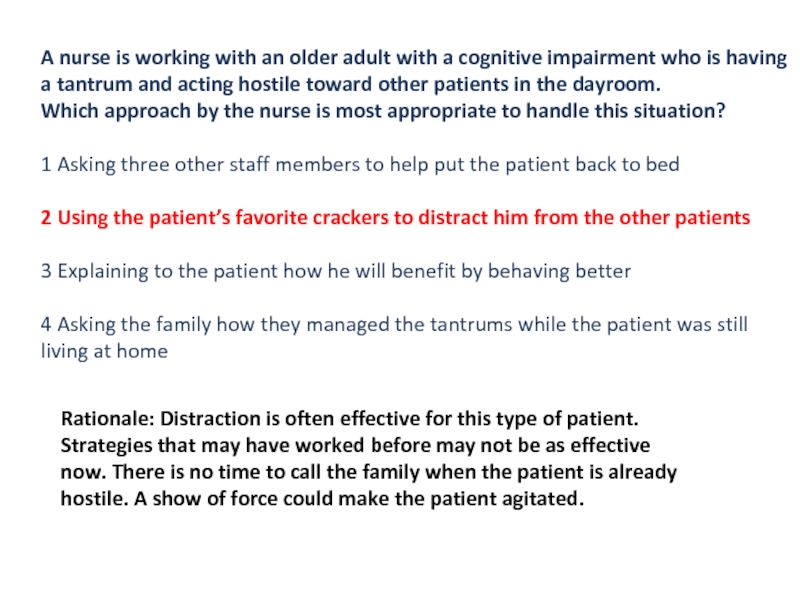
Слайд 19A nurse is working with an older adult with a

cognitive impairment who is having a tantrum and acting hostile

toward other patients in the dayroom.
Which approach by the nurse is most appropriate to handle this situation?

1 Asking three other staff members to help put the patient back to bed

2 Using the patient’s favorite crackers to distract him from the other patients

3 Explaining to the patient how he will benefit by behaving better

4 Asking the family how they managed the tantrums while the patient was still living at home

Rationale: Distraction is often effective for this type of patient.
Strategies that may have worked before may not be as effective
now. There is no time to call the family when the patient is already
hostile. A show of force could make the patient agitated.

A nurse is working with an older adult with a cognitive impairment who is having a tantrum

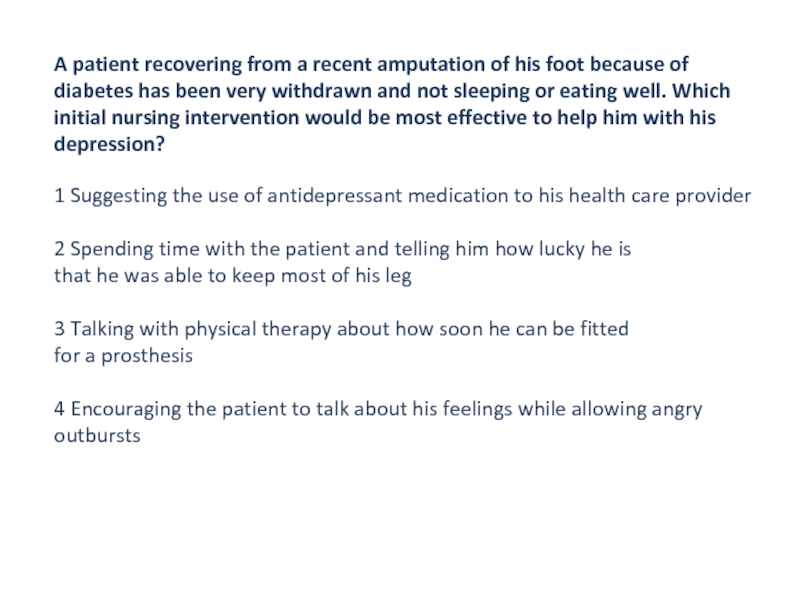
Слайд 20A patient recovering from a recent amputation of his foot

because of diabetes has been very withdrawn and not sleeping

or eating well. Which initial nursing intervention would be most effective to help him with his depression?

1 Suggesting the use of antidepressant medication to his health care provider

2 Spending time with the patient and telling him how lucky he is
that he was able to keep most of his leg

3 Talking with physical therapy about how soon he can be fitted
for a prosthesis

4 Encouraging the patient to talk about his feelings while allowing angry outbursts
A patient recovering from a recent amputation of his foot because of diabetes has been very withdrawn

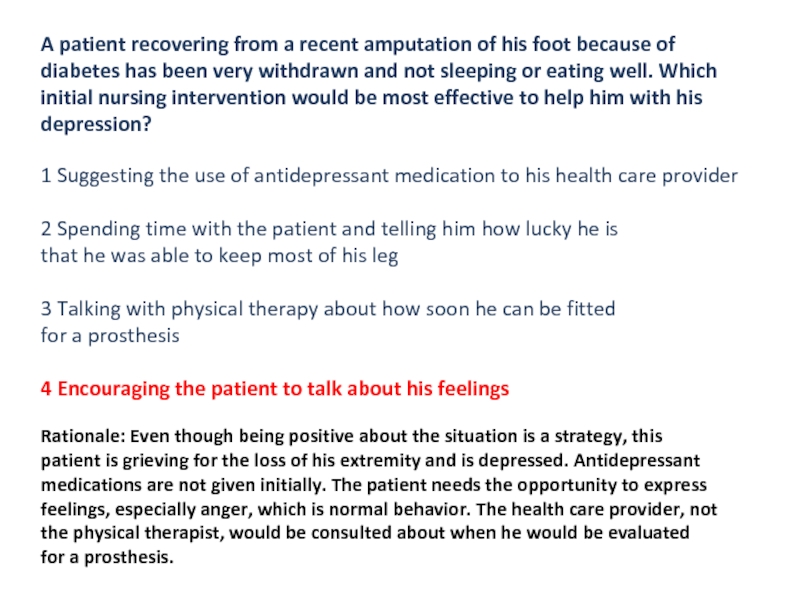
Слайд 21A patient recovering from a recent amputation of his foot

because of diabetes has been very withdrawn and not sleeping

or eating well. Which initial nursing intervention would be most effective to help him with his depression?

1 Suggesting the use of antidepressant medication to his health care provider

2 Spending time with the patient and telling him how lucky he is
that he was able to keep most of his leg

3 Talking with physical therapy about how soon he can be fitted
for a prosthesis

4 Encouraging the patient to talk about his feelings

Rationale: Even though being positive about the situation is a strategy, this patient is grieving for the loss of his extremity and is depressed. Antidepressant medications are not given initially. The patient needs the opportunity to express feelings, especially anger, which is normal behavior. The health care provider, not the physical therapist, would be consulted about when he would be evaluated
for a prosthesis.

A patient recovering from a recent amputation of his foot because of diabetes has been very withdrawn

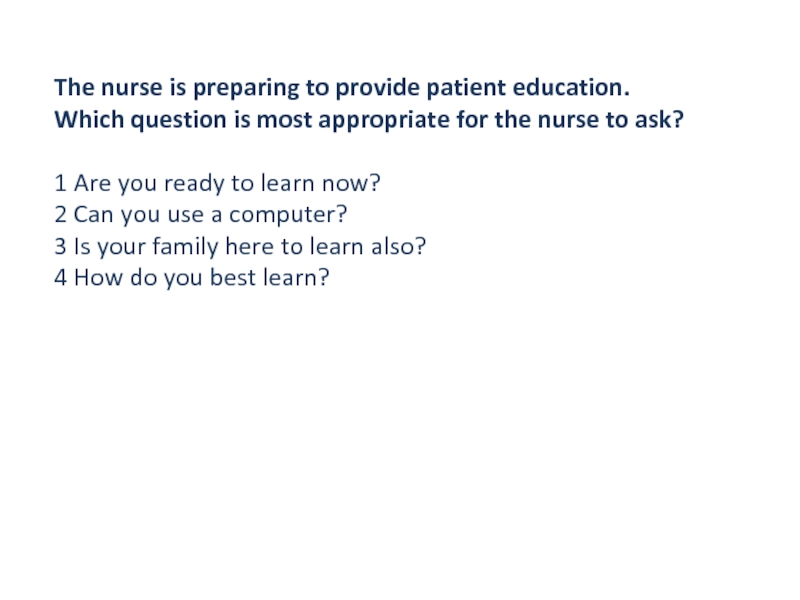
Слайд 22The nurse is preparing to provide patient education.
Which question

is most appropriate for the nurse to ask?

1 Are you

ready to learn now?
2 Can you use a computer?
3 Is your family here to learn also?
4 How do you best learn?
The nurse is preparing to provide patient education. Which question is most appropriate for the nurse to

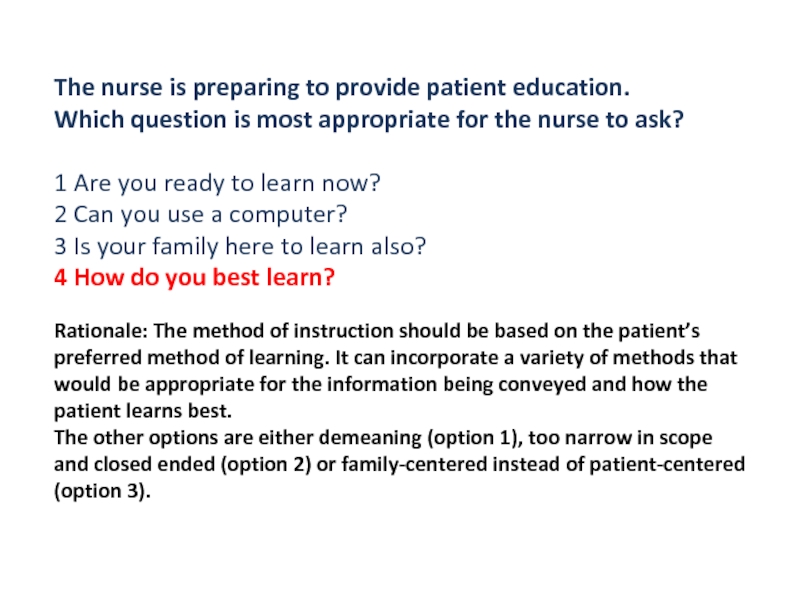
Слайд 23The nurse is preparing to provide patient education.
Which question

is most appropriate for the nurse to ask?

1 Are you

ready to learn now?
2 Can you use a computer?
3 Is your family here to learn also?
4 How do you best learn?

Rationale: The method of instruction should be based on the patient’s preferred method of learning. It can incorporate a variety of methods that would be appropriate for the information being conveyed and how the patient learns best.
The other options are either demeaning (option 1), too narrow in scope and closed ended (option 2) or family-centered instead of patient-centered
(option 3).

The nurse is preparing to provide patient education. Which question is most appropriate for the nurse to

Обратная связь

Если не удалось найти и скачать доклад-презентацию, Вы можете заказать его на нашем сайте. Мы постараемся найти нужный Вам материал и отправим по электронной почте. Не стесняйтесь обращаться к нам, если у вас возникли вопросы или пожелания:

Email: Нажмите что бы посмотреть 

Что такое TheSlide.ru?

Это сайт презентации, докладов, проектов в PowerPoint. Здесь удобно  хранить и делиться своими презентациями с другими пользователями.


Для правообладателей

Яндекс.Метрика